
Automotive
Networks engineered around the production line.
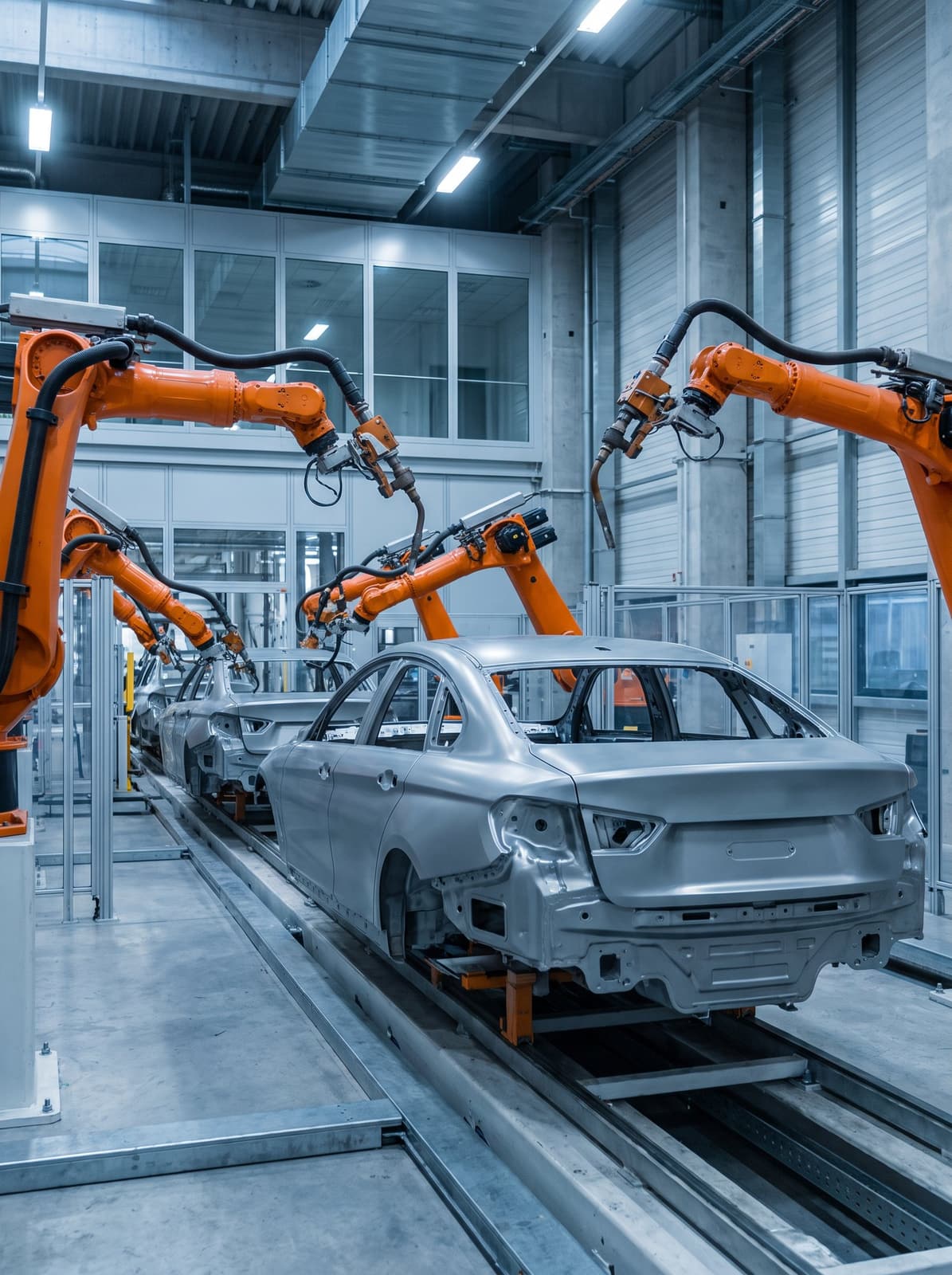
Automotive plants run continuous, synchronised production in which minutes of network downtime stop the line.
What makes it hard
The challenges we are asked to remove.
- Production lines where minutes of downtime carry immediate cost
- Deterministic industrial protocols sharing the estate with corporate IT
- Robotic, PLC and vision equipment spanning decades of technology generations
- Wireless dependency for AGVs, tooling and material movements
- OEM security requirements flowing down through the supply chain
Diagram showing automotive plant technology as connected layers: production line and robotics network interfaces, industrial networking and segmentation, plant-wide wireless coverage, operational communications and public address, CCTV, access control and logistics gates, all supported by managed operations.
Sector context
What makes automotive technology different
On a synchronised assembly line the network is part of production, not a service supporting it. Industrial Ethernet carrying motion and I/O traffic works to cycle times and jitter budgets far tighter than office networks require, so behaviour tolerated on a corporate estate, slow spanning-tree reconvergence or unmanaged multicast, arrives as a stopped line. Safety functions can run over the same media. EN ISO 13849-1 requires the safety-related parts of a control system to be designed to a required performance level and the level achieved to be verified against it, so changes touching those parts are not routine network work.
IEC 62443-3-2 requires the system under consideration to be divided into zones and conduits on the basis of a documented risk assessment, so segmentation follows process risk rather than network convenience. IATF 16949, applied alongside ISO 9001 by organisations supplying production parts, sets requirements for contingency planning and for traceability, which depends on data capture continuing while a switch is replaced. TISAX, operated by the ENX Association against the VDA ISA catalogue, provides a mechanism for exchanging information-security assessment results across the automotive supply chain, so a buyer should confirm the status of any organisation receiving prototype data.
Relevant capabilities
How we respond.
Industrial Ethernet and plant-floor networking
OT and IT segmentation with secure remote access
Wireless design for AGVs and material handling
CCTV, access control and perimeter integration
Structured monitoring and lifecycle support
Certifications, framework positions and sector references are stated only once verified. Relevant evidence is shared during qualification, subject to confidentiality.
Next step
Bring the complete environment into one conversation.
Tell us what you are planning, replacing, integrating or trying to stabilise. We will help define the right next step.